
There was a time when a 22-year-old college student could walk into a Vermont bar carrying a perfectly valid Massachusetts driver’s license and discover that Massachusetts had apparently lost the power to determine the ages of its own citizens.
The student had three better options: obtain a Vermont driver’s license, carry a passport, or pay five dollars for a Vermont liquor control identification card. A federal document was acceptable. A document issued by another state was not. Welcome to federalism, Vermont-style.
This was not folklore. From the late 1980s into the mid-1990s, Vermont maintained an identification system that made the State’s own documents—and eventually a passport—the recognized means of proving age for alcohol purchases. The system became especially familiar to out-of-state college students, who lined up on campus with birth certificates and photographs to obtain what everyone called a “liquor ID.”
The legal story begins with the Twenty-first Amendment, which returned broad authority over alcohol to the states after Prohibition. Vermont used that authority enthusiastically. In 1971, it lowered its drinking age to 18. Then Congress entered the room.
The National Minimum Drinking Age Act of 1984, now codified at 23 U.S.C. § 158, did not directly order the states to adopt a drinking age of 21. Congress merely threatened to withhold federal highway money from states that declined. Two years later, Vermont enacted 1985 Acts and Resolves No. 99 (Adjourned Session), raising the legal age from 18 to 21 effective July 1, 1986. People who had reached 18 by June 30 were grandfathered. Contemporary reports described Vermont as the last Northeastern state to make the change.
In South Dakota v. Dole, decided in 1987, the United States Supreme Court upheld Congress’s arrangement as a valid use of the Spending Clause. The Court called the loss of highway funds a financial “inducement,” not unconstitutional coercion. Congress called it a choice. States responsible for paving roads probably used a different word.
Vermont did not invent the liquor ID for the 1986 age increase. The General Assembly had created the card in 1963. Former 7 V.S.A. § 601 allowed an eligible adult to apply to the Liquor Control Board using a certified birth record, a photograph, and whatever additional information the Board required. For five dollars, the applicant received a tamper-proof photographic card that became valid when signed.
After the drinking age changed, eligibility belonged to people who were 21 or who fell within the grandfather clause. A 1989 amendment added another distinctly Vermont feature: no liquor ID could be issued to anyone over 30. Apparently, by age 31 the Legislature believed nature had supplied sufficient proof.
The statute did not say that the card was solely for students or nonresidents. It was available to anyone who qualified. But Vermont residents who drove already possessed a Vermont license. The obvious customers were nondrivers, newcomers, and out-of-state students whose home-state licenses did them little good at a Vermont bar. The card was not legally a student document. It became one as a matter of administrative ecology.
The distrust of foreign—that is, out-of-state—identification predated the 21-year-old drinking age. In Louis Anthony Corp. v. Department of Liquor Control, the Vermont Supreme Court considered a 30-day suspension imposed on a South Royalton bar after it served a 15-year-old who presented a New York identification card stating that she was 18. General Liquor Regulation 13 required a licensee confronting a person of questionable age to demand either an adult identification card issued by the Liquor Control Board or a photographic operator’s license issued by the Vermont Department of Motor Vehicles.
The bar attempted to raise a constitutional challenge to the regulation. The Supreme Court did not decide it because the issue had not been properly presented and certified. Because the violation itself was admitted, the suspension stood. The reported decision therefore never tells us whether Vermont could constitutionally distrust New York. It tells us only that the bar paid the price for trusting it.
The Legislature made the preferred-document structure clearer in 1989. Acts and Resolves No. 195 rewrote former 7 V.S.A. § 602 to recognize the liquor control card, a Vermont photographic operator’s license, and a valid passport. A United States military identification card was not added until 1995. Out-of-state and foreign driver’s licenses did not enter the authorized list until the 1997 adjourned-session amendment replaced repeated references to “Vermont” documents with valid documents issued by Vermont, another state, or a foreign jurisdiction.
For a remarkable period, therefore, a passport could get a Norwich University student a beer, but a Norwich military identification card could not. This is what law professors mean when they say a statutory classification should be examined in context.
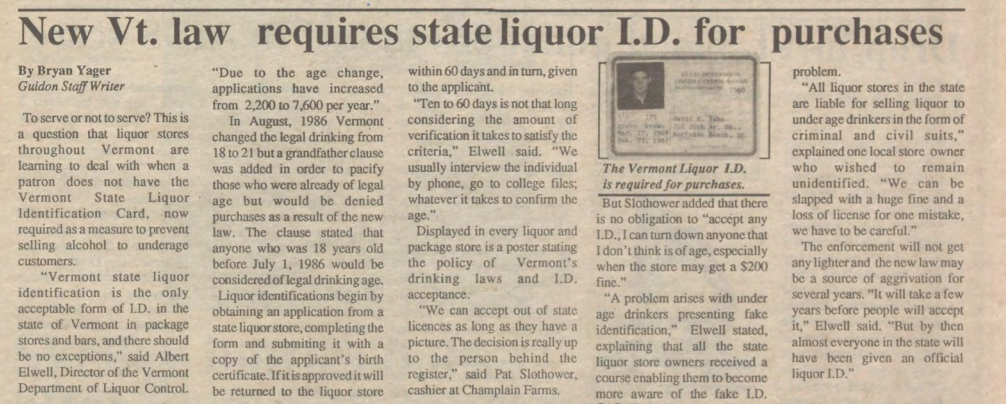
Middlebury Magazine reported in the winter of 1987 that restaurants, bars, and convenience stores could no longer accept out-of-state licenses or college IDs. More than 500 students appeared at the campus security office on the first day of liquor-card registration. Liquor Control employees later returned to verify the applications and discovered several underage freshmen who had supplied false information.
The Norwich Guidon reported in 1988 that annual applications had climbed from about 2,200 to 7,600 after the drinking age changed. For an out-of-state student, the process could involve a birth certificate, a photograph, a wait of 10 to 60 days, telephone interviews, and checks of college records. By 1992, the Guidon was again warning out-of-state students that local merchants would not risk fines or their licenses by accepting the wrong document. The practical advice was straightforward: spend five dollars and obtain the Vermont card.
The legal mechanism mattered. Former § 602 did more than provide a list for bartenders to memorize. Sale to a person displaying an authorized form of identification constituted prima facie evidence that the licensee had complied with the prohibition against sales to minors. That is an evidentiary safe harbor. It did not make a fake Vermont card magically true, but it shifted the licensee’s legal position dramatically.
Conversely, accepting an unauthorized document left the licensee exposed. The law may not always have said that a bartender was physically forbidden to look at a New Jersey license. It said, in substance, that the State would protect reliance on certain documents and might suspend the license if reliance on something else proved mistaken. For a person whose livelihood depended on that license, the distinction between “prohibited” and “permitted entirely at your own risk” was largely academic.
That is why the liquor ID regime is best understood not simply as an identification program but as a statutory allocation of error. Vermont decided that the risk of a false age claim would fall on the seller unless the seller demanded evidence the State had chosen to trust. The five-dollar card converted an administrative investigation into an evidentiary presumption.
The system gradually became less parochial. Vermont added military and nondriver identification in 1995, accepted out-of-state and foreign licenses through the 1997 adjourned-session amendment, and repealed the separate liquor-card statute through Act 114 of the 2007 adjourned session. Today, 7 V.S.A. § 589 recognizes photographic driver’s licenses and nondriver IDs from Vermont, other states, and foreign jurisdictions, along with military IDs and passports. It retains the old idea that reliance on an authorized document is prima facie evidence of compliance.
The liquor ID belonged to a particular moment: after Vermont raised the drinking age, before identification documents became technologically standardized, and while the State believed the best answer to fake IDs was to manufacture one more ID.
Underage drinking and drunk driving were serious problems. The policy was not irrational. Still, there is something almost comforting about the scale of the response. Vermont mobilized statutes, regulations, inspectors, campus registration lines, certified birth certificates, photographs, interviews, five-dollar fees, fines, and license suspensions to answer a single question: may this college student buy a beer?
We did not eliminate underage drinking.
But for a while, we laminated it.